

Social media marketing is the practice of using social media channels to sell or promote a brand, product or service.
Social media marketing helps businesses:
- Increase brand awareness
- Build engaged communities
- Sell products and services
- Measure how people feel about your business
- Provide customer service on social media platforms
- Advertise their products and services to target audiences
- Track your performance and adjust your strategy accordingly
A social media strategy is a document outlining your social media goals, the tactics you will use to achieve them and the metrics you will track to measure your progress.
Your social media marketing strategy should also list all of your existing and planned social media accounts along with goals specific to each platform you’re active on. These goals should align with your business’s larger digital marketing strategy.
Finally, a good social media plan should define the roles and responsibilities within your team and outline your reporting cadence.
- Choose social media marketing goals that align to business objectives
- Learn everything you can about your audience
- Get to know your competition
- Do a social media audit
- Set up accounts and improve profiles
- Find inspiration
- Create a social media content calendar
- Create compelling content
- Track performance and adjust your strategy accordingly
Read on for more detail on each step of the process.
Step 1. Choose social media marketing goals that align to business objectives
Set S.M.A.R.T. goals
The first step to creating a winning strategy is to establish your objectives and goals. Without goals, you have no way to measure success and return on investment (ROI).
Each of your goals should be:
- Specific
- Measurable
- Attainable
- Relevant
- Time-bound
This is the S.M.A.R.T. goal framework. It will guide your actions and ensure they lead to real business results.
Here’s an example of a S.M.A.R.T. goal:
“We will use Twitter for customer support and lower our average response rate to under two hours by the end of the quarter.”
Track meaningful metrics
Vanity metrics like number of followers and likes are easy to track, but it’s hard to prove their real value. Instead, focus on things like engagement, click-through, and conversion rates.
For inspiration, take a look at these 19 essential social media metrics.
You may want to track different goals for different social media networks, or even different uses for each network.
For example, if you use LinkedIn to drive traffic to your website, you would measure click-throughs. If Instagram is for brand awareness, you might track the number of Instagram Story views. And if you advertise on Facebook, cost-per-click (CPC) is a common success metric.
Social media goals should align with your overall marketing objectives. This makes it easier to show the value of your work and secure buy-in from your boss.
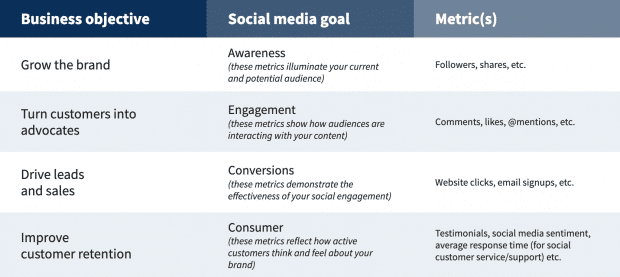
Start developing a successful social media marketing plan by writing down at least three goals for social media.
Step 2. Learn everything you can about your audience
Create audience personas
Knowing who your audience is and what they want to see on social media is key. That way you can create content that they will like, comment on, and share. It’s also critical if you want to turn social media followers into customers for your business.
When it comes to your target customer, you should know things like:
- Age
- Location
- average income
- Typical job title or industry
- Interests
- etc.
Here’s a simple guide and template for creating audience/buyer personas.
Get to know your fans, followers, and customers as real people with real wants and needs, and you will know how to target and engage them on social media.
Gather data
Don’t make assumptions. Think Facebook is a better network for reaching Baby Boomers than Millennials? Well, the numbers show that Facebook’s largest age demographic is actually 30-49.
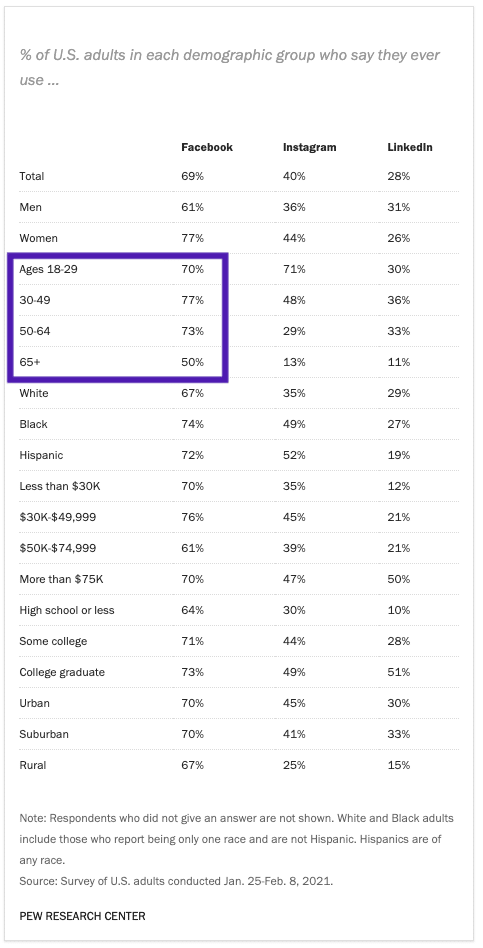
Social media analytics can also provide a ton of valuable information about who your followers are, where they live, and how they interact with your brand on social media. These insights allow you to refine your strategy and better target your audience.
Jugnoo, an Uber-like service for auto-rickshaws in India, used Facebook Analytics to learn that 90% of their users who referred other customers were between 18- and 34-years-old, and 65% of that group was using Android. They used that information to target their ads, resulting in a 40% lower cost per referral.
Check out our guide to using social media analytics and the tools you need to track them.
Step 3. Get to know your competition
Odds are your competitors are already using social media, and that means you can learn from what they’re doing.
Conduct a competitive analysis
A competitive analysis allows you to understand who the competition is and what they’re doing well (and not so well). You’ll get a good sense of what’s expected in your industry, which will help you set social media targets of your own.
It will also help you spot opportunities.
Maybe one of your competitors is dominant on Facebook, for example, but has put little effort into Twitter or Instagram. You might want to focus on the networks where your audience is underserved, rather than trying to win fans away from a dominant player.
Use social media listening
Social listening is another way to keep an eye on your competitors.
Do searches of the competition’s company name, account handles, and other relevant keywords on social media. Find out what they’re sharing and what other people are saying about them.
Pro tip: Use a social media management tool like Hootsuite to set up listening streams to monitor relevant keywords and accounts in real-time.
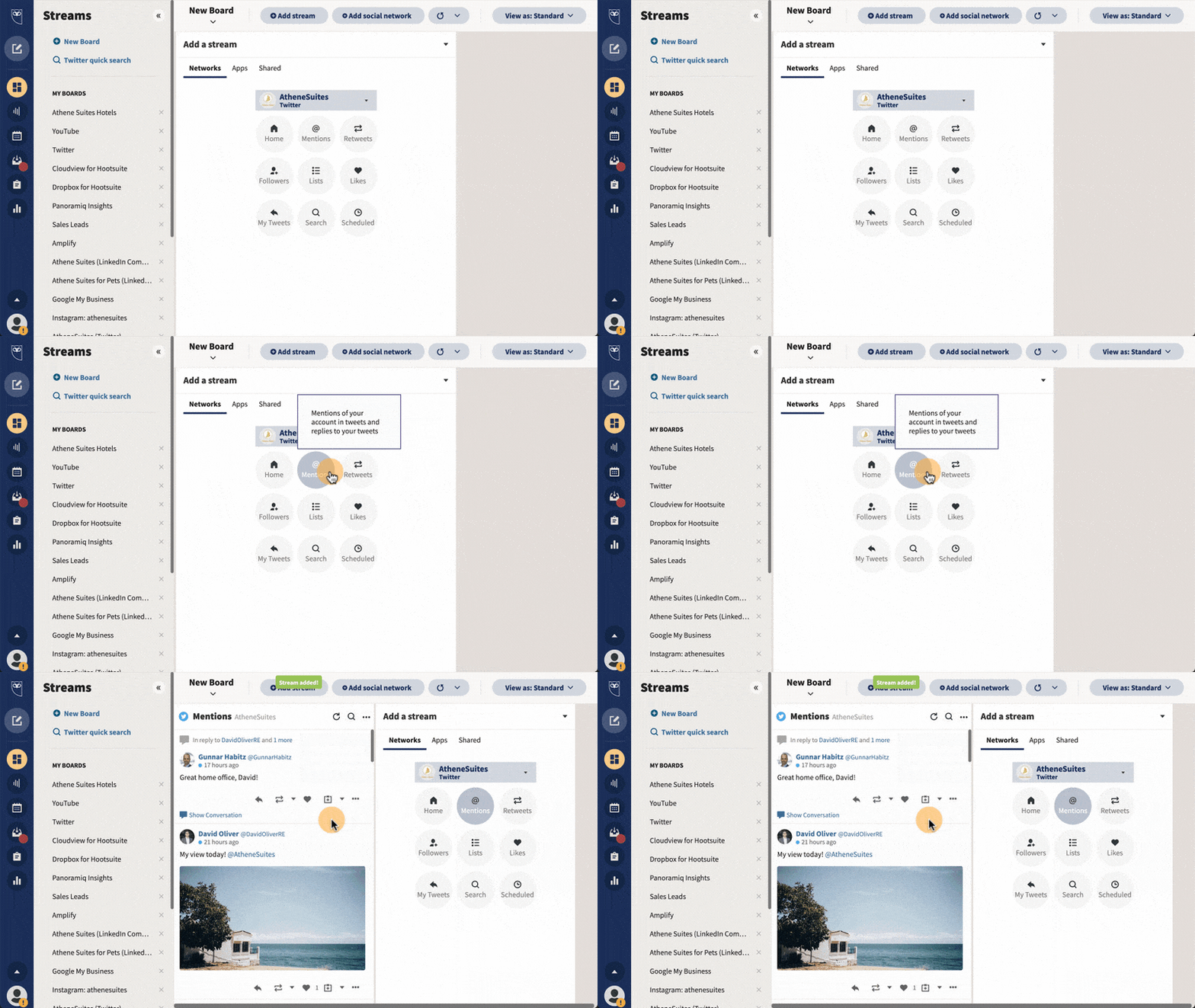
As you track, you may notice shifts in the way channels are used. Or, you might spot a specific post or campaign that really hits the mark—or totally bombs.
Use this kind of intel to inform your own social media marketing strategy.
Step 4. Do a social media audit
If you’re already using social media, take stock of your efforts so far. Ask yourself the following questions:
- What’s working, and what’s not?
- Who is engaging with you?
- Which networks does your target audience use?
- How does your social media presence compare to the competition?
Once you collect that information, you’ll be ready to start thinking about ways to improve.
We’ve created an easy-to-follow social media audit guide and template to walk you through each step of this process.
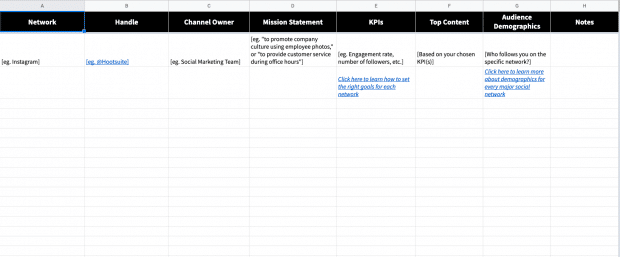
Your audit should give you a clear picture of what purpose each of your social accounts serves. If the purpose of an account isn’t clear, think about whether it’s worth keeping.
To help you decide, ask yourself the following questions:
- Is my audience here?
- If so, how are they using this platform?
- Can I use this account to help achieve my goals?
Asking these tough questions will keep your strategy focused.
Look for impostor accounts
During the audit, you may discover fake accounts using your business name or the names of your products.
These imposters can be harmful to your brand—never mind that they’re capturing followers that should be yours.
Report them.
You may want to get your accounts verified too to ensure your fans know they are dealing with the real you.
Here’s how to get verified on:
- TikTok
Step 5. Set up accounts and improve profiles
Decide which networks to use
As you decide which social networks to use, you will also need to define your strategy for each.
Benefit Cosmetics’ social media manager, Angela Purcaro, told eMarketer: “For our makeup tutorials … we’re all about Snapchat and Instagram Stories. Twitter, on the other hand, is designated for customer service.”
Hootsuite’s own social team even designates different purposes for formats within networks. On Instagram, for example, they use the feed to post high-quality educational infographics and product announcements and Stories to cover live events or quick social media updates.
